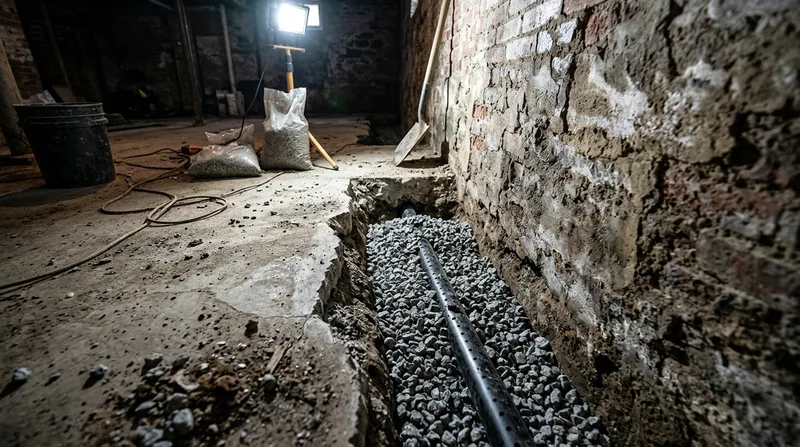




Interior Drain Tile System in Springfield
Springfield sits on the flat floor of ancient glacial Lake Hitchcock, and that geology decides how water moves around your foundation. The layered lake-bottom clay and silt hold water like a shallow bowl. When the Connecticut River runs high and spring snowmelt soaks the valley, the water table rises, and hydrostatic pressure pushes groundwater against every footing from Sixteen Acres to the McKnight district. An Interior Drain Tile System in Springfield intercepts that water at the footing, before it reaches your slab, and moves it to a sump basin where a pump sends it outside. We install these systems year-round, including deep winter, because the work happens inside the basement, not in frozen ground. If you are weighing options, start with our basement waterproofing overview.
Why Springfield Basements Take On Water
The building stock here tells the story. Victorian and Queen Anne homes in Forest Park Heights and Maple Hill sit on brick and brownstone foundations set in old lime mortar. Triple-deckers in Hungry Hill and Liberty Heights have full basements dug into clay. Capes and ranches in Sixteen Acres and East Forest Park sit on block foundations from the 1950s through the 1970s. Poured-concrete basements in Longmeadow and Agawam date from the 1980s forward. Different materials, same problem: the valley clay will not drain, so water stacks up against the wall.
- Hydrostatic pressure pushes water through mortar joints and hairline cracks in old brick foundations.
- Efflorescence (the white salt bloom on basement walls) shows water is moving through the masonry.
- Spring snowmelt and nor'easters drive the water table up fast, and the footing drain cannot keep up.
- Connecticut River flooding, as seen during Tropical Storm Irene in 2011, overwhelms older weeping tile and saturated soil.
When the water is coming up through the slab or seeping at the wall base, crack sealing alone will not fix it. That is the point where an interior perimeter drain is the honest answer.
Key info: On Mattoon Street, brick rowhouses often show seepage at the footing line rather than the middle of the wall. That pattern points to a rising water table, not a failing wall, and an interior drain tile system targets it directly.
Before you commit to any repair, check what the City of Springfield building department requires for drainage work on your property, because rules vary by jurisdiction.
How We Install an Interior Drain Tile System in Springfield
We work from the inside, so we do not excavate around your foundation, destroy plantings, or wait for the ground to thaw. The sequence is the same on a 1910 triple-decker in Chicopee as it is on a 1990s Colonial in Wilbraham. We break out a channel along the perimeter of the slab, dig down to the footing, and lay perforated pipe in washed stone. The pipe carries water by gravity to a sump basin set into the lowest corner of the floor.
- We inspect the basement and mark the slab edge, the sump location, and the discharge route.
- We cut and remove a 12 to 16 inch channel of concrete along the perimeter wall.
- We excavate to the footing and install perforated drain tile in a gravel bed with filter fabric.
- We set the sump basin, connect the drain tile, and install the pump with a check valve.
- We run the discharge line to daylight or a dry well, then pour a new concrete cap over the channel.
- We test the system with water and confirm the pump cycles and the basin empties.
The finished floor is patched clean, and the system runs quietly under the slab from that day forward. Pairing the drain with a sump pump installation is standard, and we size the pump to the volume your footing actually produces.
Key info: A Forest Park foursquare on a full basement had water standing two inches deep after every March thaw. We installed 96 linear feet of interior drain tile and a 1/3 HP submersible pump. The floor has stayed dry through three spring melt seasons since.
Interior Drain Tile Approaches We Use
Not every basement needs the same configuration. The right approach depends on the foundation material, the water volume, and whether the wall itself is moving. Here is how we match the method to the house.
| Approach | Description | Best for |
|---|---|---|
| Full perimeter interior drain | Continuous perforated tile along all four walls, feeding one sump basin. | Widespread seepage and a rising water table. |
| Partial perimeter drain | Tile along the wet wall or walls only, tied to a single basin. | Isolated seepage on one side of the foundation. |
| Drain tile with dimple board | Drain tile plus a dimple membrane on the wall to channel seepage down. | Old brick and brownstone walls that weep through the masonry. |
| Drain tile with battery backup | Standard drain tile and basin with a backup pump on battery power. | Homes that lose power during nor'easters and ice storms. |
| Drain tile plus wall stabilization | Drain tile installed alongside carbon fiber straps or wall anchors. | Bowing walls where pressure has already moved the block. |
We will tell you plainly when a simpler fix is enough. If the water enters through one crack and the wall is plumb, epoxy or polyurethane injection may solve it, and you do not need a drain.
Interior Drain Tile System Cost in Springfield: What to Expect
Pricing for interior drain tile starts at From $50 per linear foot in the Springfield market. That figure covers the channel cut, excavation to the footing, perforated tile, gravel, filter fabric, and the concrete patch. The sump basin, pump, check valve, and discharge line are priced separately because the pump size and discharge route change from house to house. A 40 foot run on a small ranch is a different job than 120 feet around a triple-decker.
- Linear footage is the main driver, since every foot of wall means concrete cutting and excavation.
- Slab thickness matters: older homes sometimes have a thicker pour that takes longer to cut.
- Access to the basement, including narrow bulkhead stairs, adds labor on tight triple-decker lots.
- Discharge route affects cost, since running the line to daylight may require a longer trench.
- Wall condition can add scope if the drain is installed alongside bowing wall repair.
Get two or three written estimates before you sign, and make sure each one lists the pump model and the linear footage. Our full pricing overview breaks down the line items.
Interior Drain Tile System Near Me: Hiring a Contractor Near Springfield
You want a contractor who works below grade every week, not a general handyman who owns a jackhammer. Ask for proof of licensing and insurance, and request a certificate of insurance before work starts. Ask how many interior drain systems the crew has installed in Hampden County, and ask for references from homes with the same foundation type as yours. Confirm who pulls the permit if the work touches the sanitary connection of the sump discharge, because the local building department sets that threshold.
- Verify the contractor is licensed and insured, and get the certificate in writing.
- Get at least three estimates with linear footage and pump model spelled out.
- Ask for local references and call them, especially on older brick foundations.
- Confirm the permit responsibility for drainage and discharge work in Springfield.
- Check HOA rules on exterior discharge and dry well placement before work begins.
We are a Basement Health Association member, and we hand you a transferable warranty on the installation. Reach out through our contact page to schedule a free inspection.
Interior Drain Tile System in Springfield: Pricing Guide
| Service | Price | Details |
|---|---|---|
| Partial perimeter interior drain | Starting at $50/linear ft | Includes channel cut, perforated tile, gravel, fabric, and concrete patch on the wet wall. |
| Full perimeter interior drain | From $50/linear ft | Continuous tile on all four walls; total driven by linear footage and slab access. |
| Drain tile with sump basin and pump | On estimate | Pump size, basin depth, and discharge route are quoted after the on-site inspection. |
| Drain tile with battery backup | On estimate | Adds a battery backup pump for nor'easter and ice storm power outages; priced per system. |
| Travel | Included | In Springfield and surrounding Pioneer Valley towns, no separate call-out or mileage fee. |
| Estimate | Free | Response within 24 hours at (413) 288-3958, no obligation to book. |
Indicative pricing, the exact cost depends on square footage, finish, and site access. Free personalized estimate within 24h at (413) 288-3958.


